Go to content

Project description - ECOLABEL

Ładowanie...
Skip menu
PL
EN
this is the project Ecolabel logo
Ładowanie...
Skip menu
PL
EN
EU Tire labelling

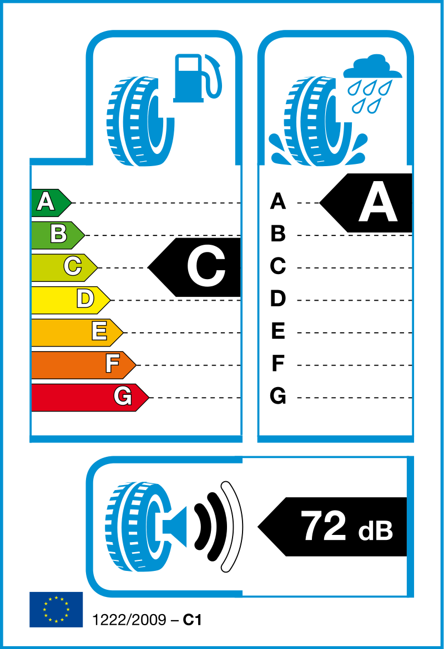
Tire labels in the European Union were introduced in 2012 to help consumers make informed purchasing decisions when they replace their tires, providing clear and relevant information about the quality of the tires with regard to three parameters:

  • fuel efficiency,
  • wet grip,
  • external rolling noise.

The Regulation (EC) 1222/2009 of the European Parliament and of the Council on the labelling of tyres with respect to fuel efficiency and other essential parameters became applicable on November 1st, 2012.
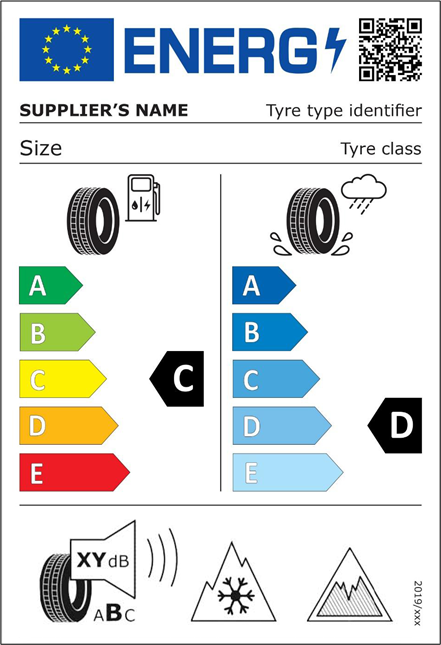
A new Regulation (EU) 2020/740 , replacing the old one, is applicable from May 1st, 2021.

The obligation of labelling was extended to cover bus and truck tires. The new regulation introduced also options to show if the tires are suitable for use:

  • in severe snow conditions (Snow Grip Marking),
  • in extreme climatic situations (Ice Grip Marking).
Unfortunately, after more than a decade of experience with tire labelling, it is widely recognized that the methods used to determine the labelling parameters are not sufficiently representative of real-life conditions. According to the current labelling procedure, defined in UN/ECE Regulation 117, external tire noise is measured using a test vehicle equipped with a set of tested tires coasting on an ISO test track with a standardized, very quiet road surface, not found on public roads. Rolling resistance is tested indoors, with the tire rolling on a drum with a smooth steel surface instead of typical, textured pavement. Noise tests are performed at 20°C, rolling resistance at 25°C (even for winter tires), despite the average year-round air temperature in Europe being only about 9°C. Additional concerns include uncertainties related to test track and vehicle variations, differences in test equipment and tire sampling. Numerous scientific studies have shown that the noise and rolling resistance values indicated on tire labels do not adequately correspond to values obtained under real road traffic conditions.

This international research project ECOLABEL (Environmental Consumer-Oriented Labelling Advancement for Better tire energy Efficiency and Lower external noise) addresses all these issues.

Project objectives

The project aims to propose a new, advanced, consumer-oriented methodology for testing and classifying car tires, which will result in enhanced energy efficiency of tires and reduced noise emissions into the environment. The new methodology will move all labelling tests indoors, where tires will be tested on a drum equipped with a strictly defined replica of the reference road surface.
Project structure

ECOLABEL project consists of 7 interdependent work packages, that ensure a comprehensive approach from data collection to methodology validation and impact assessment:

WP 1:  Evaluation of current tire labels and selection of tires and road surfaces for testing purposes including specification of a representative road surface for tire labelling
WP 2:  Development and manufacturing of a new reference road surface replica for noise and rolling resistance testing
WP 3:  Determination of representativity of the enhanced indoor tire testing method regarding noise for real road condition
WP 4:  Determination of representativity of the enhanced indoor tire testing method regarding energy efficiency for real road conditions
WP 5:  Proposal and validation of the enhanced tire labelling procedure for noise
WP 6:  Validation of the enhanced tire labelling procedure for rolling resistance
WP 7:  Cost benefits analyses of the enhanced indoor tire labelling method end evaluation of its impact on environment
Project implementation plan

First, the most popular road surface in Europe will be identified as the reference. A 3D scanning method will be used to develop its model, based on which replicas of this surface will be manufactured. The used improved technology will be thoroughly described and made publicly available. The standardized reference surface model can be used to produce replicas e.g. by tire industry.
 
Next, on selected sections of typical pavements in Poland and Switzerland, as well as in the laboratory on corresponding road surface replicas, measurements of external noise and rolling resistance will be conducted to determine the representativeness of the new method for selected numerous tires.
 
Following, after producing 3 variants of replicas according to the 3D model of the reference surface, the proposed method will be validated by road and laboratory tests.

Finally, compared to the current labelling methodology, cost-benefit analyses justifying the introduction of the new method in financial terms will be conducted, concluding with an assessment of its environmental impact
Expected project outputs

By the end of the project, the Technology Readiness is expected to reach Level 7 - system prototype demonstrated in operational environment (the initial TRL was 2 which involved formulating the technology concept and application, along with preliminary assessments of its feasibility and potential impact). This advancement will enable a tangible shift from laboratory validation to market-ready application, reducing the innovation adoption gap. A structured roadmap for commercialization will be implemented, including early involvement of tire manufacturers through co-development agreements and memoranda of understanding, ensuring alignment with market needs.
 
To support broad market adoption, a clear go-to-market strategies will be defined, including phased integration with existing regulatory frameworks and certification processes. A dedicated task force will identify and engage early adopters within the tire manufacturing sector and key mobility actors. The project will establish measurable Key Performance Indicators (KPIs), such as reduction in tire testing costs (target: >20%), certification time (target: >30% faster) and increase in consumer adoption of eco-labelled tires (target: >15% within 2 years of market introduction).
The project’s results will be positioned for industrial uptake through targeted workshops aimed at product developers in the tire and automotive industries. This will accelerate the adoption of the developed innovations across multiple European markets.
 
From a societal perspective, the project will contribute to safer, more sustainable mobility by enabling consumers to make more informed choices. Through improved labelling and environmental performance transparency, the project supports climate goals and fosters a shift towards greener consumption. In the long term, societal benefits include reduced greenhouse gas emissions, improved urban air quality, and a stronger circular economy in the automotive sector.


Back to content